Periacetabular Osteotomy (PAO)
What is Periacetabular Osteotomy (PAO)?
Periacetabular Osteotomy (PAO) is a specialised hip preservation surgery designed to correct structural problems of the hip joint, most commonly hip dysplasia. Hip dysplasia occurs when the hip socket (acetabulum) is too shallow or poorly positioned, meaning it does not adequately cover or support the ball of the hip joint (femoral head). Over time, this abnormal shape places excessive stress on the cartilage and labrum, leading to pain, instability, and early osteoarthritis.
PAO is performed by carefully cutting the bone around the hip socket and repositioning it into a more stable, anatomically correct alignment. Once repositioned, the socket is secured with screws, allowing the bone to heal in its new position. The goal of PAO is to improve joint mechanics, reduce pain, preserve the patient’s natural hip, and delay or prevent the need for a total hip replacement.
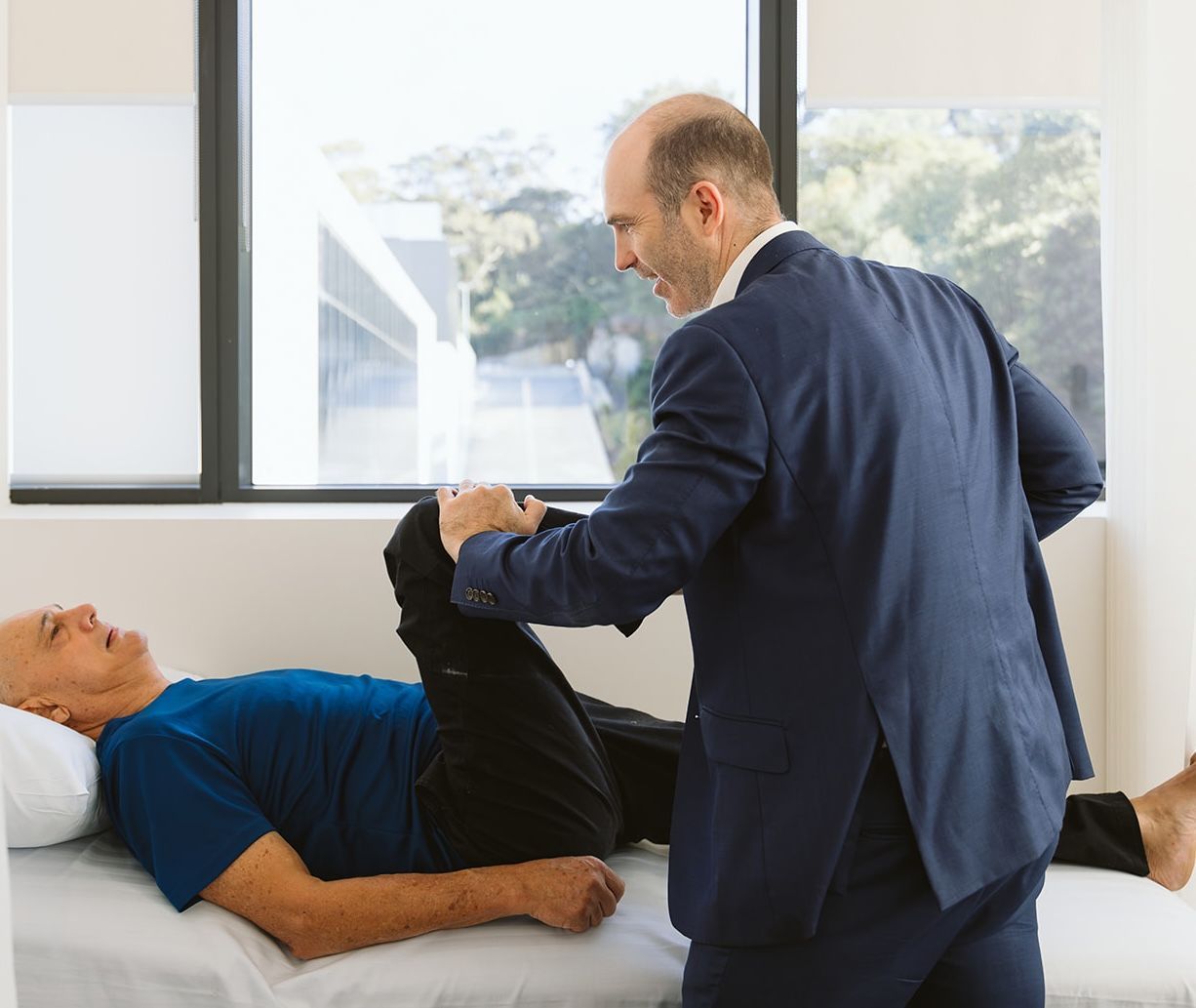
Unlike hip replacement surgery, PAO preserves the patient’s own joint.
Dr Williams is one of a few surgeons in NSW to offer this subspecialised procedure and performs it regularly in his paediatric and adult practice. After finishing his general orthopaedic training, Dr Williams undertook 18 months of extensive further training in periacetabular osteotomy under the expert mentorship of Dr Lachlan Milne in Perth, Western Australia. Dr Williams has also undertaken PAO observerships with highly experienced PAO surgeons, Dr Jit Balakumar and Dr Michael Solomon, to refine his technique.
Who is Suitable for Periacetabular Osteotomy (PAO)?
PAO is not suitable for everyone with hip pain. Careful patient selection is essential to achieve good outcomes.
- Young adults and adolescents: The typical age of an ideal PAO patient is between the mid teens to early 40s. Most adults over 40 with diagnosed hip dysplasia are better off managing without surgery until their symptoms warrant a hip replacement. Over 40, hip replacement has a more reliable outcome, easier recovery and potential to last many decades.
- Diagnosed hip dysplasia: Shallow or maloriented hip socket confirmed on X-rays and advanced imaging
- Preserved joint cartilage: Minimal to mild arthritis rather than advanced joint degeneration
- Hip pain related to activity: Pain that affects walking, sports, or daily activities
- Good overall health: Fit enough to undergo major orthopaedic surgery and rehabilitation
- Motivated patients: Willing to commit to a long recovery and physiotherapy program
PAO is not recommended for patients with dysplasia and severe hip arthritis, as a total hip replacement will provide better outcomes in these patients.
Benefits of Periacetabular Osteotomy (PAO)
PAO offers several important benefits when performed for the right patient at the right time.
- Preserves the natural hip joint: Avoids or delays the need for hip replacement
- Improves hip stability: Better coverage of the femoral head reduces joint stress
- Reduces pain: Correcting alignment often relieves activity-related pain
- Improves function: Allows improved walking, movement, and participation in sports
- Slows arthritis progression: Better load distribution protects cartilage
- Long-term durability: Many patients maintain good hip function for decades
For young and active individuals, these benefits can be life-changing, allowing continued participation in work, family life, and physical activity.
Types of Periacetabular Osteotomy (PAO)
There are several different surgical techniques described for periacetabular osteotomy, which was a procedure developed by Reinhold Ganz in Bern, Switzerland, in the early 1980s.
The original technique has been modified over the years to be more minimally invasive and muscle-sparing. In particular, the gluteal muscles and the rectus femoris are protected during the procedure, allowing an easier early recovery.
Dr Williams uses this muscle-sparing modification of the original Bernese periacetabular osteotomy.
Alternative Options to Periacetabular Osteotomy (PAO)?
Not all patients require or are suitable for PAO. Alternatives may be considered depending on age, symptoms, and joint condition.
- Non-surgical management: Physiotherapy, activity modification, pain relief, and injections. Dr Williams recommends that ALL patients who are diagnosed with adolescent and adult hip dysplasia undertake at least 3-6 months of targeted physiotherapy before considering surgery. When the bony anatomy is deficient, building up the strength of the hip girdle can be highly effective in relieving symptoms of overload and instability.
- Hip arthroscopy alone: For patients with mild/borderline dysplasia and labral tears. For true dysplasia, hip arthroscopy (keyhole hip surgery) on its own is not appropriate and may, in fact, make things worse.
- Other osteotomies: In selected cases, femoral osteotomy to correct femoral alignment may be required. This can be performed in isolation or in combination with PAO.
- Total hip replacement: For patients with advanced arthritis or unsuitable anatomy
As a hip preservation specialist who is trained in all of the above techniques, Dr Williams will make a thorough and individualised assessment to determine the most appropriate treatment pathway for you.
Preparation Before a Periacetabular Osteotomy (PAO)
Preparation before PAO plays a significant role in recovery and outcomes.
- Detailed assessment: X-rays, MRI, CT scans, and clinical examination
- Prehabilitation: Strengthening core and hip muscles before surgery
- Medical optimisation: Managing weight, nutrition, and general health
- Medication review: Adjusting blood thinners or supplements as advised
- Home preparation: Organising mobility aids, help at home, and transport
- Education: Understanding the procedure, hospital stay, and recovery timeline
Dr Williams always encourages you to ask questions and fully understand the commitment required for recovery.
Periacetabular Osteotomy (PAO) Procedure
PAO is a complex surgical reconstructive procedure. It is always performed under a general anaesthetic, usually with a combination of a spinal block, epidural or nerve block.
In general principles, the steps of the operation are as follows:
- Surgical approach: An incision is made at the front of the hip. Dr Williams uses an oblique incision, which respects the tension lines of the skin (Langers lines) and so usually heals with a very nice scar. While the required scar is 10-15cm long, it is positioned such that it can usually be hidden by swimwear or undies, which is often an important cosmetic consideration for young PAO patients.
As part of the surgical approach, the hip flexor muscle is lifted off the inside of the pelvis to expose the bone, causing difficulty with lifting and moving the leg on its own for 6 weeks, with improvement thereafter.
- Bone cuts: Precise cuts are made around the acetabulum while preserving key structures. Live X-ray is used to guide the accuracy of these cuts.
- Reorientation: The socket is repositioned to improve femoral head coverage. The desired position varies from patient to patient and is checked and rechecked with intraoperative X-rays before the final position is chosen. A range-of-motion assessment of the hip is also performed to ensure that adequate range remains after socket repositioning.
- Fixation: Dr Williams typically used 4-5 stainless steel screws to hold the socket in its new position while the bone heals (which typically takes 6-8 weeks).
- Additional procedures: Dr Williams will often open the hip joint capsule to perform a reshaping of the femoral neck if there is a cam deformity, which can be done through the same incision. Some patients will also require a femoral derotation osteotomy (to realign the femur) in addition to PAO, which is done through a separate incision on the side of the thigh.
- Skin closure: Your wound will be closed using several layers of dissolvable sutures. The final skin layer will be carefully closed with a dissolvable running suture below the skin, then sealed with surgical glue and a waterproof dressing, leaving no visible sutures to be removed.
PAO surgery typically takes 2-3 hours, though it can be longer depending on complexity and whether any additional procedures are required.
What to Expect After a Periacetabular Osteotomy (PAO)?
Recovery from PAO is gradual and requires patience.
- Hospital stay: Usually 3-5 days. The main goals of the first few days are: pain control, regaining enough mobility to get in and out of bed and to the bathroom, gentle mobilisation with crutches and dealing with any issues like nausea or lightheadedness that can arise.
- Pain management: Dr Williams works closely with his anaesthetist and the acute pain service at his hospital to keep patients as comfortable as possible. Multimodal analgesia is used to control pain, including different medications (often paracetamol, celecoxib, tapentadol), spinal anaesthetic, local anaesthetic catheter and cryotherapy.
- Weight-bearing: Dr Williams usually prescribes 20% weightbearing with crutches for 4 weeks, upgrading to 50% for weeks 4-6 if tolerated. Beyond 6 weeks, many patients can fully weight-bear with a single crutch if needed. Progression of weight-bearing is, however, individual and depends on technical factors such as the amount of bone correction required and patient factors such as age and pre-surgery conditioning.
- Physiotherapy: Begins in the hospital and continues for several months after surgery. Dr Williams will give your physiotherapy team clear guidelines on progressing through the various stages of recovery.
- Return to work: Desk-based work may resume after 4-6 weeks; physical jobs will take longer depending on demands.
- Return to sport: Usually 6–12 months, depending on progress
Improvement continues for up to 12–18 months as strength and mobility return.
Periacetabular Osteotomy (PAO) Prognosis
When performed for appropriate patients, PAO has excellent long-term outcomes.
- Pain relief: Significant improvement in most patients. Approximately 90% of patients are highly satisfied with their results.
- Function: Improved walking, stability, and activity tolerance
- Longevity: Many hips remain functional for 15–25 years or longer. The younger the patient is at the time of PAO surgery, typically the longer their native hip will ‘last’ before requiring possible total hip replacement in the future.
- Delayed replacement: One of the goals of PAO surgery is that replacement can often be avoided or delayed until an older age. Whilst this is likely to be the case, there aren’t any long-term studies that have proven this, given the difficulties of longitudinal study design over many decades.
Prognosis is best in younger patients with minimal arthritis and good surgical correction.
Periacetabular Osteotomy (PAO) Risks
As with any major surgery, PAO carries risks, although serious complications are uncommon in experienced hands.
- Minor nerve injury: Minor injury to the skin nerves, in particular the lateral femoral cutaneous nerve (LFCN), is a well-recognised risk of PAO surgery. Whilst any surgical incision can result in some numbness around the scar, it is not uncommon after PAO surgery (50-75%) to have numbness further down the thigh due to the inevitable stretch of the LFCN. The good news is that symptoms tend to improve over 12 months, and because it is only a skin nerve, hip muscle function is not affected.
- Major nerve injury: One of the most serious potential complications of PAO surgery is injury to the major motor nerves of the leg, the sciatic and femoral nerves. If this occurs, it can result in temporary or permanent weakness of some of the muscles in the leg. Fortunately, this is a rare (1%) complication in experienced hands, and Dr Williams takes many special precautions throughout the operation to minimise this risk.
- Blood loss: There is usually a moderate amount of controlled blood loss during PAO surgery as the bone of the pelvis is very vascular. Dr Williams usually uses a blood-recycling technology called ‘Cell-Saver’ during PAO cases so that a patient’s own blood is given back to them during the surgery. This reduces the risk of requiring a donated blood transfusion.
- Delayed bone healing: Non-union or slow healing of bone cuts (about 10%). Very rarely, an additional procedure may be required to achieve bone healing.
- Post-operative stress fracture: As a thin portion of the ‘posterior column’ is maintained for stability during PAO, excessive load through this bone during post-op mobilisation can cause a stress fracture. This usually heals with off-loading on crutches.
- Incomplete relief of pain: A risk of any joint-preserving surgery is some ongoing pain or limitation from that joint, because the body’s structures, along with their nerve endings, are being reconstructed, rather than replaced. Whilst the risk of this is low, if it does occur, Dr Williams will work with you to manage things and optimise your outcome. Occasionally, secondary procedures such as keyhole hip surgery are required.
- Over or under-correction of the acetabular position: An inherent risk of the PAO procedure is that the dysplastic hip socket can be moved too far or not far enough. This may result in ongoing pain or dysfunction. Dr Williams uses intra–operative live X-ray and multiple checks to carefully assess the correction before fixing it, to minimise this risk.
- Infection: Superficial or deep surgical site infection
- Blood clots: Risk of deep vein thrombosis or pulmonary embolism
Careful surgical planning and postoperative care help minimise these risks.
What if Periacetabular Osteotomy (PAO) is Delayed?
The timing of PAO surgery is an important decision that Dr Williams will consider carefully with you. Whilst untreated dysplasia can lead to labral tears, cartilage injury and progressive arthritis over time, this process usually occurs over years to decades, rather than months. As such, PAO surgery is rarely, if ever, urgent, and delaying by several months or years to fit in with life events such as school and university holidays, major trips, or milestones is often very reasonable.
Over the very long term, putting off PAO may result in:
- Progressive cartilage damage: Ongoing abnormal joint loading
- Worsening pain: Increasing limitation in daily and sporting activities
- Development of arthritis: May reduce future surgical options
- Reduced effectiveness: PAO is less successful once arthritis advances
- Earlier hip replacement: Loss of opportunity to preserve the natural joint