Revision (re-do) Hip Replacement
What is Revision (re-do) Hip Replacement?
In a revision (re-do) hip replacement, Dr Williams replaces part or all of a hip replacement that is no longer functioning as intended. Unlike a primary (first-time) hip replacement, revision surgery involves working on an artificial joint that has already been implanted. This makes the procedure more complex, more individualised, and often more technically demanding.
A hip replacement is designed to last many years, often 15–25 years or more. However, occasionally hip replacements fail earlier than expected, while others wear out gradually over time. When this happens, revision hip replacement may be required to restore comfort, stability, and function, and to prevent further damage to the surrounding bone and soft tissues.
Revision hip replacement is not simply a “repeat” of the original operation. Each revision is unique and tailored to the specific reason the original hip replacement failed, the condition of the bone and muscles, and the patient's overall health and activity level.
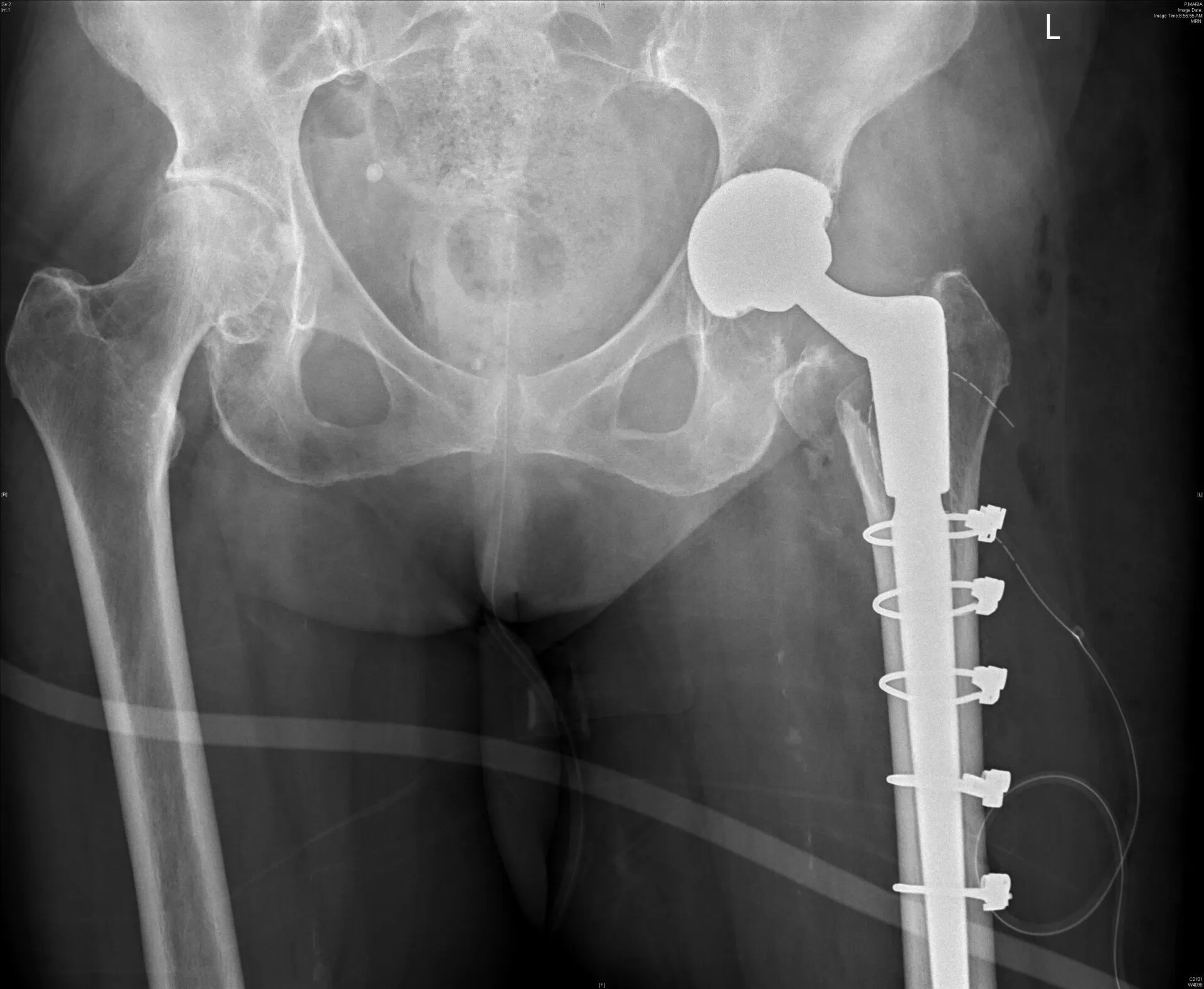
Why Would Hip Revision Surgery Be Required?
Modern total hip replacements have excellent bearing surfaces that hardly wear out at all. The old myth that a hip replacement needs to be redone after 10-15 years due to wear is not true. In fact, the most common reason for revision hip replacement isn’t ‘wearing out’ of the mechanical parts but rather a failure of the implant’s function within the body.
From a patient's perspective, the main symptom leading to revision is pain; however, instability can also be a cause.
The main causes of a painful hip replacement that might need revision include:
Loosening
When hip replacements are implanted, they are designed to achieve secure fixation to the skeleton, either through the use of bone cement or by a process of ‘on-growth’ where the bone bonds to the implant. When this bond breaks down, it is known as ‘loosening’.
It usually occurs over time and is more common in highly active individuals. It may be asymptomatic, but it can also be painful and require revision of the part that has come loose.
Infection
Infection of an artificial joint is very serious, as bacteria can form a ‘biofilm’ on implants that makes antibiotic treatment alone ineffective. Deep infection, therefore, usually requires surgical treatment, such as joint washout or replacement of some or all of the implants.
Infection can occur early after surgery or, less commonly, years down the track, if bacteria in the bloodstream seed onto the artificial joint. It usually presents with pain, but may also present with an acute fever or a general feeling of being unwell.
Fracture
If a person with a hip replacement has a severe fall, the bone around the implant may break. This is known as a peri-prosthetic fracture, which usually occurs in the femur. If the fracture compromises the implant's stability in the bone, it needs to be fixed, and often a new, longer stem must be inserted.
Dislocation
Hip replacements can dislocate, meaning the ball comes out of the socket. If this happens repeatedly, a revision hip replacement may be required to adjust the position of the components to improve the stability.
Wear
This can be caused by wear of the plastic (polyethylene) and is one of the easier revisions, in which only the plastic insert is replaced. It is less and less common these days due to the use of highly wear-resistant plastic.
How Revision Hip Replacement Differs from Primary Hip Replacement
Revision hip replacement is generally more complex than first-time surgery for several reasons:
- Previous surgery: Scar tissue and altered anatomy make the operation more technically challenging.
- Bone loss: Loosening, infection, or difficulty extracting previous implants may reduce the amount and quality of bone available to support a new implant.
- Specialised implants: Revision surgery often requires longer stems, larger cups, bone grafts, or custom components.
- Longer operating time: Revision procedures usually take more time than primary hip replacements.
- Higher risk profile: Risks such as infection, blood loss, and dislocation are typically higher than in first-time surgery.
Despite this, revision hip replacement can be highly successful when performed for the right reasons and with careful planning.
Types of Revision Hip Replacement
Revision hip replacement can vary significantly depending on the nature of the correction required.
- Partial revision: Only one component of the hip replacement (either the socket or the stem) is replaced.
- Total revision: Both the femoral (thigh bone) and acetabular (hip socket) components are replaced.
- Single-stage revision for infection: In selected cases, the infected implant is removed and replaced in the same operation.
- Two-stage revision for infection: The infected implant is removed first and replaced by a temporary ‘spacer’, followed by a period of antibiotics, then a new hip replacement is inserted in a second operation.
- Complex reconstruction: Severe bone loss may require bone grafting, metal augments, or custom-made implants.
Preparation Before a Revision Hip Replacement
- Dr Williams will thoroughly investigate the cause of your painful hip replacement to confirm the diagnosis and establish the need for revision. Required tests may include:
- X-ray, CT scan, bone scan, MRI
- Blood tests to rule out infection / increased metal ion levels
- Joint aspiration to look for infection
- Obtaining your old operation records is important as it helps to plan for their removal and replacement. You may be asked to assist with this.
- Dr Williams will organise the complex equipment needed for your surgery to optimise the chance of success. This often involves having multiple contingency plans available.
- There are a few steps you can take from a patient perspective to get the best outcome:
- Undertake appropriate pre-hab if able
- Preparation of the home environment for recovery
- Arranging necessary social supports for the post-op period
- Arranging the necessary equipment for afterwards
- Undertake any necessary scans, blood tests and cardiology reviews that Dr Williams requires
Revision Hip Replacement Procedure
Revision hip replacements vary significantly depending on what parts of the hip replacement actually need to be revised. Very minor revisions, such as exchanging the femoral head or cup liner, are often straightforward and take less than an hour.
More complex revisions, on the other hand, such as removing a well-fixed stem and cup for infection and replacing them with a spacer, can be much more time-consuming, taking up to 3-4 hours.
Anaesthetic:
- Most revision surgeries are performed under general anaesthetic, often with the addition of a spinal anaesthetic and a urinary catheter is used.
Approach:
- Dr Williams may perform an anterior approach for simpler revisions, such as head or liner exchange, though he often prefers an extensile posterior approach for complex revisions.
Implants:
- Revision implants are often necessary to gain enough fixation once bone ‘stock’ has been reduced by a loose implant or during the extraction process. 3D planning based on a personalised CT is often used to predict the required parts.
Revision Hip Replacement Recovery Plan
As revision hip replacement is often more complex than primary hip replacement, the recovery may be slower, with more restrictions in place.
- Weightbearing: Dr Williams may prescribe a period of reduced weightbearing to allow the bones to heal.
- Hip precautions: If a posterior approach has been used, hip precautions may be prescribed to reduce the risk of early dislocation while the soft tissues heal. Make sure you understand these precautions as explained by the hospital physio before discharge.
- Physiotherapy: Rehab will commence the first day following your operation and continue for several months with gradual progression. Dr Williams will arrange a personalised rehab plan for you and coordinate with your chosen care team.
Expected Outcomes of Revision Hip Replacement
The goal of revision hip replacement is to:
- Relieve pain
- Improve stability and movement
- Restore leg length and alignment
- Allow a return to daily activities
Most patients experience meaningful improvement after revision surgery, although outcomes are generally less predictable than with primary hip replacement. Recovery may be slower, and the final level of function may not match that of a first-time replacement, especially in complex cases.
That said, many patients regain good mobility, walk comfortably, return to social activities, and enjoy a better quality of life.
Revision Hip Replacement Surgery Risks and Complications
As with any major surgery, there are potential risks involved. The decision to proceed with surgery is based on the fact that the advantages outweigh the potential disadvantages.
Dr Williams will thoroughly explain these risks and ensure any questions are answered before surgery.
Complications can be Medical (General) or Hip-Specific.
Medical Complications include those related to the anaesthetic and to your general well-being. Almost any medical condition can occur; therefore, this list is not exhaustive. Complications include:
- Allergic reactions to medications
- Blood loss requiring transfusion, with its low risk of disease transmission
- Heart attacks, strokes, kidney failure, pneumonia, bladder infections
- Complications from nerve blocks, such as infection or nerve damage
- Serious medical problems can lead to ongoing health concerns, prolonged hospitalisation, or, rarely, death
Specific Complications to the Hip
Infection
Infection can occur with any operation. In the hip, this can be superficial or deep. Infection rates are higher after revision compared to primary hip replacement. If it happens, it can be treated with antibiotics but may require further surgery. Very rarely, your hip may need to be removed to eradicate infection.
Blood Clots (Deep Venous Thrombosis)
These can form in the calf muscles and travel to the lung (Pulmonary embolism). These can occasionally be serious and even life-threatening. You should notify Dr Williams if you get calf pain or shortness of breath at any stage.
Dislocation
This means the hip dislocates. Precautions are needed with your new hip. If a dislocation occurs, it must be reduced under anaesthesia. Rarely, this becomes a recurrent problem needing further surgery.
Fractures (Break) of the Femur (Thigh Bone) or Pelvis (Hip Bone)
This is also rare but can occur during or after surgery. This may prolong your recovery or require further surgery.
Damage to Nerves or Blood Vessels
It is also rare but can lead to weakness and loss of sensation in part of the leg. Damage to blood vessels may require further surgery if bleeding is ongoing.
Wound Irritation
Your scar may be sensitive or exhibit surrounding numbness. This typically decreases over time and does not cause any problems with your new joint.
Leg Length Inequality
Making the leg the same length as the other one can be difficult in revision surgery. Occasionally, the leg is lengthened to stabilise the hip during surgery. There are some occasions when it is simply not possible to match the leg lengths. A simple shoe raise is sometimes needed to address minor leg-length inequalities on the shorter side.
Failure to Relieve Pain/Ongoing Dysfunction
Due to the complex nature of revision hip surgery, your hip may not feel completely normal afterwards. Although improvement is usually achieved, there is still a chance of some ongoing discomfort or limp.