Surgical Hip Dislocation For Reconstruction
What is a Surgical Hip Dislocation?
Surgical Hip Dislocation for Reconstruction is a specialised orthopaedic procedure that Dr Williams has undergone further training in, which allows him to fully access the hip joint while carefully protecting its blood supply. It is primarily used to treat complex hip problems in which other approaches, such as keyhole surgery or standard open surgery, do not provide sufficient visibility or control.
The surgical technique was originally developed by a Swiss master of hip surgery, Reinhold Ganz, who designed the approach based on detailed anatomic studies of the blood supply of the hip.
It is particularly valuable for treating complex structural problems, cartilage damage, childhood hip-related deformities, or complications of previous hip surgery.
Although it is a more invasive procedure than hip arthroscopy, it remains an important option when precise reconstruction is required to improve hip function, reduce pain, and delay or avoid hip replacement.
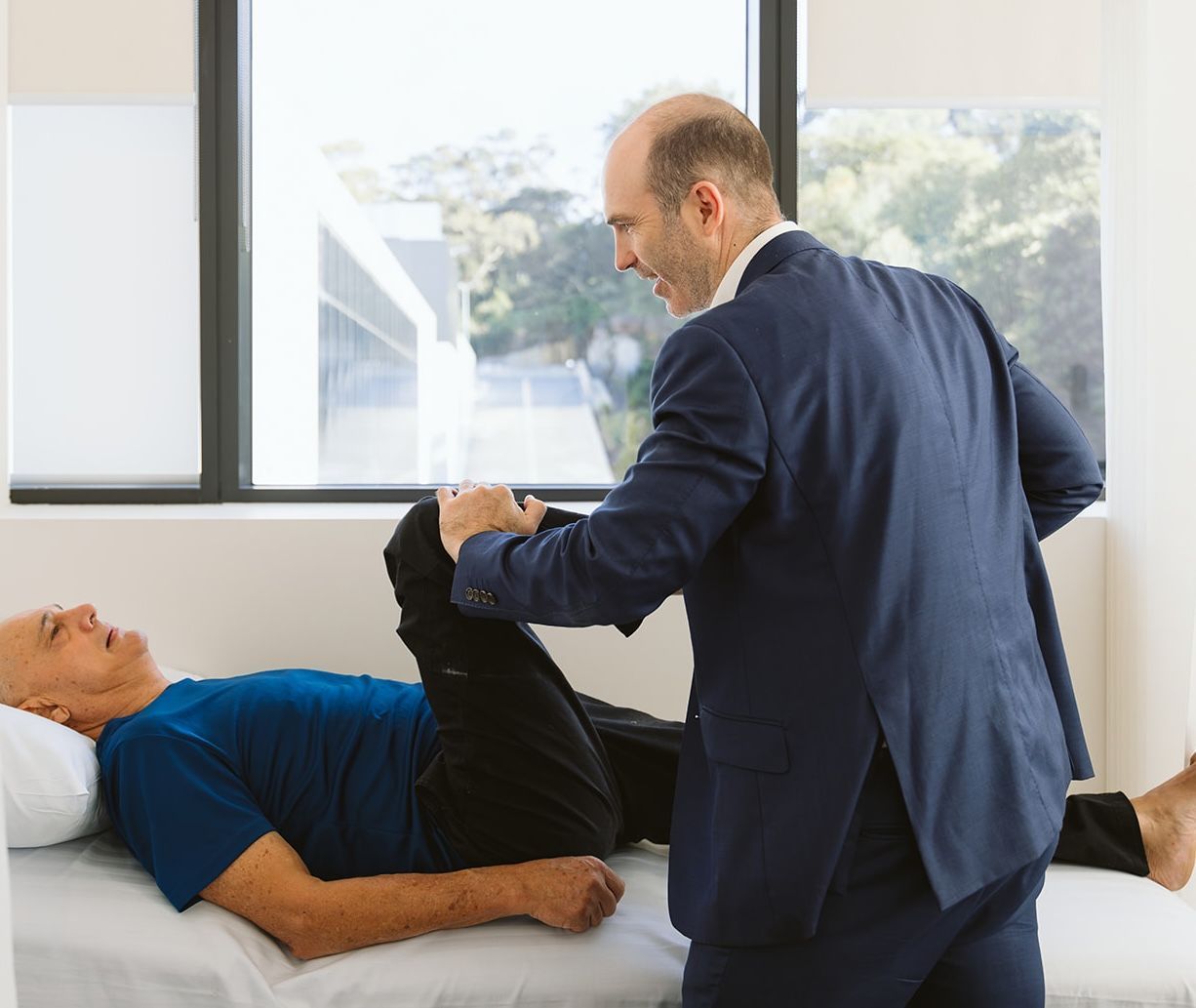
Who is Suitable for Surgical Hip Dislocation for Reconstruction?
The main reasons Dr Williams may recommend a surgical hip dislocation procedure are:
- Reconstruction of chronic Slipped Capital Femoral Epiphysis (SCFE). Dr Williams commonly performs the ‘modified Dunn’ subcapital realignment osteotomy to place the ball of the hip joint back in the centre of the neck when it has slipped out of place. In cases of healed SCFE, femoral neck osteotomy may be required.
- Perthes Reconstruction. Teenagers and young adults with pain from Perthes disease occasionally benefit from reshaping of their femoral head with ‘distalisation’ of the greater trochanter (area where the gluteal muscles attach) to improve the hip anatomy.
- Complex femoroacetabular impingement (FAI): Especially when deformities are extensive or located in areas difficult to access with keyhole surgery
- Fracture repair surgery. Certain femoral head fractures or acetabular posterior wall fractures may be best managed with a Surgical Hip Dislocation approach.
Benefits of Surgical Hip Dislocation for Reconstruction
Surgical hip dislocation offers several important advantages in carefully selected patients.
- Complete visual access to the hip joint: Dr Williams can clearly see the entire femoral head and acetabulum.
- Accurate correction of complex deformities: Including reshaping of bone and treatment of deep or widespread damage
- Preservation of blood supply: The modern technique is designed to protect the femoral head from avascular necrosis
- High precision in cartilage and labral repair: Including grafting or reconstruction when needed
- Effective treatment when other methods fail: Particularly after unsuccessful hip arthroscopy
- Potential to delay or avoid hip replacement: Especially in younger patients
For many patients, this procedure can significantly reduce pain, improve movement, and restore confidence in daily activities, work, and sport. Although it is considered a major surgery, most patients recover well, and the long-term outcomes are generally positive.
Alternative Options to Surgical Hip Dislocation
Dr Williams typically reserves surgical hip dislocation for cases in which other options have been carefully reviewed. Alternatives depend on the diagnosis, symptom severity, and patient goals.
- Non-surgical management: Physiotherapy, activity modification, pain relief, and targeted injections may help in mild or early cases
- Hip arthroscopy (keyhole surgery): Less invasive and suitable for many labral tears or mild to moderate FAI
- Periacetabular osteotomy (PAO): Used mainly for hip dysplasia to improve socket coverage
- Open hip surgery without dislocation: May be suitable for limited problems, but offers less visibility
- Hip resurfacing: An option in selected younger patients with specific arthritis patterns
- Total hip replacement: Recommended when arthritis is advanced and joint preservation is no longer realistic
Each option has its own benefits and limitations. In some cases, a combination of treatments over time may be required.
Surgical Hip Dislocation for Reconstruction Procedure
Surgical hip dislocation is performed in a hospital under general anaesthetic and usually takes 2-3 hours, depending on the complexity of the reconstruction.
- Positioning and incision: The patient is positioned on their side, and Dr Williams makes a 15-20cm straight incision on the side of the hip
- Soft tissue dissection: The iliotibial band (ITB) is split from the lateral femur up to the iliac crest, just in front of the front edge of gluteus maximus (known as the Gibson interval).
- Trochanteric flip osteotomy: The greater trochanter is carefully cut with a saw to allow the gluteus medius and vastus lateralis muscles to be moved forwards out of the way to gain access to the hip joint capsule.
- Controlled hip dislocation: A blood-supply sparing capsulotomy (cut in the hip joint capsule) is made to allow careful dislocation of the hip joint
- Reconstructive work: This may include reshaping bone, repairing or reconstructing the labrum, treating cartilage damage, or correcting deformities
- Assessment of joint movement: The hip is tested to ensure improved alignment and motion
- Relocation and fixation: The hip is returned to its normal position, the capsule is repaired, and the trochanteric osteotomy is fixed with screws
- Closure: The muscles and skin are carefully closed, and dressings are applied
The controlled nature of the dislocation allows precise treatment while minimising the risk of joint damage.
What to Expect After a Surgical Hip Dislocation for Reconstruction?
Recovery after surgical hip dislocation is gradual and requires commitment to rehabilitation. Hospital stay is usually longer than with keyhole surgery.
- Hospital stay: Typically 3–5 days, depending on pain control and mobility
- Pain management: Pain is expected initially and managed with medications and ice therapy
- Weight-bearing restrictions: You may need crutches or a walker for 6–12 weeks to protect the reconstruction
- Physiotherapy: Begins early and progresses through staged rehabilitation, focusing on movement, strength, and stability
- Activity restrictions: Twisting, deep bending, and impact activities are limited during early healing
- Wound care: The wound is usually well healed by 14 days. It should be kept covered until this point.
- Return to work: Office-based work may resume in 6–8 weeks, while physical jobs take longer
Full recovery can take 6–12 months. Progress is gradual, and improvement continues well beyond the early healing phase.
Surgical Hip Dislocation Results
Although it is a major reconstructive procedure, the long-term prognosis after surgical hip dislocation is generally quite good when performed for the right indication. Especially when used for the reconstruction of slipped capital femoral epiphysis, it has the powerful ability to restore almost normal hip function to a hip that was otherwise doomed to rapid early arthritis.
- Pain reduction: Most patients experience significant improvement in hip pain
- Improved function: Movement, strength, and daily activity tolerance typically increase
- Joint preservation: The procedure can delay or prevent the need for hip replacement, especially in younger patients
- Durability: Results are often long-lasting when arthritis is mild or absent
- Return to activity: Many patients return to work, exercise, and recreational sports, although high-impact activities may remain limited
Surgical Hip Dislocation Risks
- Infection: A small risk that may require antibiotics or further treatment
- Blood clots: Measures such as medication and early mobilisation reduce this risk
- Nerve injury: Temporary numbness or weakness may occur, but is usually short-lived
- Delayed bone healing: Particularly where bone cuts are made
- Hip stiffness: May occur without appropriate rehabilitation
- Persistent pain: Some patients may continue to experience symptoms
- Avascular necrosis: Rare with modern techniques but remains a recognised risk
- Need for further surgery: Including eventual hip replacement in some cases
Dr Williams will discuss individual risks in detail and explain how they are minimised.