Perthes
What is Perthes?
Perthes disease, also known as Legg–Calvé–Perthes disease, is a childhood hip condition that affects the ball part of the hip joint, called the femoral head. It occurs when the blood supply to the femoral head is temporarily reduced or interrupted. Without adequate blood flow, the bone becomes weak and can gradually lose its normal round shape.
Perthes disease most commonly affects children between 4 and 10 years of age, although it can occasionally be seen in younger or older children. In most cases, only one hip is affected; however, approximately 10–15% of children may develop Perthes disease in both hips, either simultaneously or at different stages.
The condition develops slowly over several years and progresses through distinct stages. During this time, the femoral head softens, partially collapses, and then gradually heals and reforms. The long-term outcome depends on factors such as the child’s age at diagnosis, the extent of femoral head involvement, and the degree of hip protection during the healing phase.
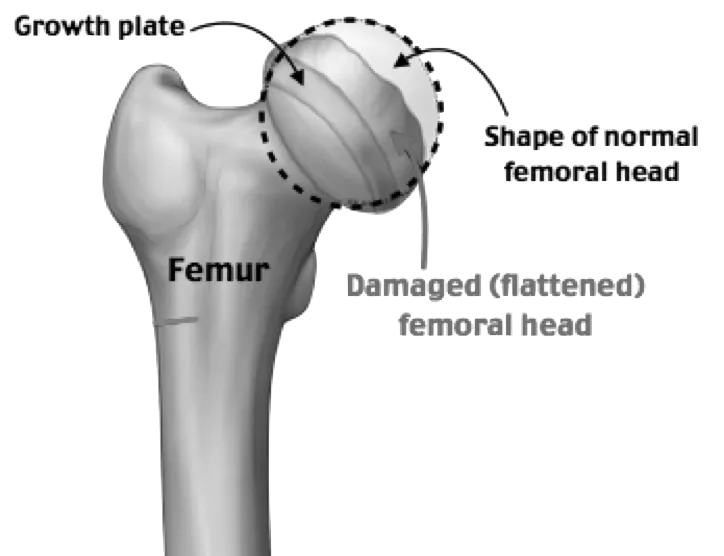
How Does Perthes Impact Your Child’s Hip?
Perthes affects the hip joint, which is a ball-and-socket joint formed by the femoral head (ball) and the acetabulum (socket) of the pelvis. A healthy femoral head is smooth and round, allowing pain-free movement. When the blood supply is disrupted, several anatomical and functional changes can occur.
- Femoral head weakening: The lack of blood flow causes part of the femoral head bone to die (avascular necrosis), making it softer and more vulnerable to damage
- Loss of round shape: As the softened bone bears weight, it may flatten or collapse, changing the natural shape of the hip joint
- Joint incongruity: If the femoral head no longer fits smoothly into the socket, joint movement becomes less efficient and more painful
- Muscle tightness: Pain and altered movement often lead to the tightening of surrounding muscles, particularly the hip flexors and adductors
- Reduced hip motion: Stiffness may develop, especially with rotation and abduction (moving the leg away from the body)
From a broader health perspective, Perthes can impact a child’s mobility, physical activity, and quality of life during critical years of growth and development. It can certainly be a frustrating condition for both affected children and their parents, and social supports are important. Potential long-term consequences may include:
- Reduced participation in sports or physical activities
- Impacted mental health
- Leg length difference, usually mild but occasionally noticeable
- Persistent hip pain into adulthood
- Early-onset hip osteoarthritis
With early diagnosis and appropriate care, many children go on to have good hip function and lead active adult lives.
Risk Factors for Perthes
Perthes is relatively uncommon, and its incidence appears to be decreasing; certain theorised risk factors exist.
- Age: Most commonly diagnosed between 4 and 10 years, with peak incidence around 5–7 years
- Sex: More common in boys than girls, at a ratio of approximately 4:1
- Family history: A small number of cases show a genetic tendency, suggesting inherited factors may play a role
- Low birth weight or delayed growth: Children who are smaller for their age or have slower growth rates appear to have a higher risk
While these factors may increase risk, many children with Perthes have no identifiable risk factors, and the condition often appears unexpectedly.
Causes of Perthes
The exact cause of Perthes disease remains uncertain, which can be frustrating for families. It is well understood that the condition involves a temporary disruption of blood flow to the femoral head, but the mechanisms underlying this phenomenon remain under investigation.
Several theories have been proposed:
- Vascular interruption: Temporary blockage or spasm of small blood vessels supplying the femoral head
- Blood clotting abnormalities: Some children may have mild clotting tendencies that reduce blood flow
- Mechanical factors: Repeated minor stress or loading on a developing hip may contribute
- Genetic influences: Certain genes may affect bone development or blood vessel formation
- Environmental factors: Passive smoke exposure and nutritional factors may play a contributory role
Symptoms of Perthes
Common symptoms include:
- Limping: Often painless initially, and may be more noticeable after activity.
- Hip pain: Usually mild to moderate and may come and go
- Referred pain: Pain may be felt in the thigh or knee rather than directly in the hip
- Stiffness: Reduced hip movement, particularly with rotation
- Fatigue with walking: Children may tire easily or avoid running and jumping
- Muscle wasting: Reduced use of the affected leg can lead to wasting of thigh muscles over time
Symptoms are often worsened with physical activity and improve with rest. As the disease progresses, pain and stiffness may become more noticeable, especially if the femoral head begins to lose its shape.
Preventing Perthes
While prevention is not possible, the following strategies can help optimise outcomes:
- Early assessment: Any child with a persistent limp or hip, thigh, or knee pain should be medically evaluated. Assessment may need to include blood tests to exclude infection (also common in this age group), physical examination by a trained professional, and x-rays.
- Activity modification: Reducing high-impact activities can protect the femoral head during healing
- Maintaining hip mobility: Physiotherapy may help preserve joint movement and muscle strength
- Regular follow-up: Ongoing monitoring allows treatment to be adjusted as the condition evolves
Stages of Perthes
Perthes disease progresses through four well-recognised stages, usually over several years. Understanding these stages helps explain why symptoms change over time and why treatment strategies may differ across stages.
- Initial (Necrosis) Stage: Blood supply to the femoral head is reduced, causing part of the bone to die and weaken. The collapsed femoral head may appear denser and smaller on X-ray.
- Fragmentation Stage: The weakened bone begins to break down as the body resorbs the dead bone, causing a fragmented appearance. The ball is particularly susceptible to flattening and collapsing in this stage.
- Reossification Stage: New bone starts forming as blood supply returns and healing begins
- Remodelling (Healing) Stage: The femoral head reshapes and strengthens, with the final shape determining the long-term outcome
The fragmentation stage is often the most critical, as this is when the femoral head is most vulnerable to deformation. Treatment during this phase focuses heavily on protecting the hip joint by off-loading and maintaining the range of movement.
The full disease process typically lasts 2 to 5 years, though this varies between individuals.
Diagnosis of Perthes
Diagnosing Perthes requires a combination of clinical assessment, imaging, and careful follow-up. Because early symptoms can be subtle, diagnosis may sometimes be delayed.
- Clinical history: A child with a limp, hip pain, thigh pain, or unexplained knee pain
- Physical examination: Reduced hip movement, especially rotation and abduction
- X-rays: The primary diagnostic tool, showing changes in the femoral head shape and density compared to the other side
- MRI scans: Useful in early disease when X-rays may still appear normal, though not routinely used. Limited utility in children under 5 due to the need to lie still.
Treatment for Perthes
Management of Perthes is usually non-operative and aims to preserve hip shape, maintain mobility, and reduce long-term joint damage. Non-surgical treatment options include:
- Activity modification: Reducing high-impact activities such as running and jumping. Dr Williams is quite conservative with his recommendations and often suggests complete off-loading with the use of a wheelchair during the fragmentation and early remodelling stages, when the head is most at risk.
- Pain management: Using simple pain relief medications when needed
- Physiotherapy: Maintaining hip movement and muscle strength
- Observation: Regular imaging and clinical reviews are required, usually every 4-6 months
Dr Williams may rarely recommend surgical treatment in moderate to severe cases, particularly in older children:
- Femoral osteotomy: Repositioning the femoral head to improve containment in the socket
- Pelvic osteotomy: Adjusting the acetabulum to better cover the femoral head
- Combined procedures: Used in complex cases to optimise joint alignment
The concept of “containment” is central to Perthes treatment. Keeping the femoral head well seated in the socket allows it to heal into a rounder, more functional shape.
Usually, this is achievable with non-operative measures.
What if Perthes is Untreated?
If Perthes disease is left untreated or poorly monitored, outcomes can be unpredictable and, in some cases, suboptimal.
Potential consequences include:
- Permanent femoral head deformity: Leading to poor joint mechanics
- Chronic hip pain: Persisting into adolescence and adulthood
- Reduced hip mobility: Affecting walking, sports, and daily activities
- Leg length difference: Usually mild but occasionally noticeable
- Early hip osteoarthritis: Often developing in early to mid-adulthood
- Need for hip replacement: Sometimes required at a younger age than usual
The risk of these complications is higher in older children, those with severe disease, and those who lose hip containment during the fragmentation stage.
On the other hand, younger children (under 6 at diagnosis) tend to have a better result regardless of treatment.