Slipped Capital Femoral Epiphysis
What is Slipped Capital Femoral Epiphysis?
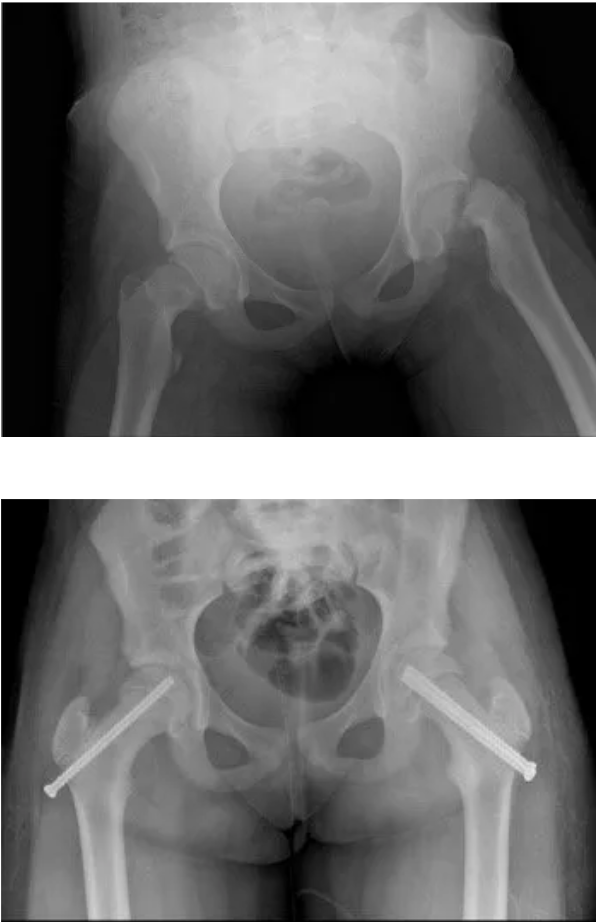
Slipped Capital Femoral Epiphysis (SCFE) is one of the most common hip conditions that Dr Williams manages in children and adolescents while they are still growing. It occurs when the ball at the top of the thigh bone (the femoral head) slips in relation to the neck of the bone. This slip occurs through the growth plate, a softer area of cartilage near the end of long bones in children and adolescents.
It is treated as an orthopaedic emergency. Once diagnosed, the patient should be made non-weight-bearing and same-day advice should be sought from an orthopaedic surgeon, even if this means presentation to the Emergency Department.
In SCFE, the ball stays in the socket, but the neck of the thigh bone shifts forward, making it appear as though the ball has slipped off the neck. If untreated, this misalignment can lead to avascular necrosis, severe impingement and the need for early hip replacement.
How Does Slipped Capital Femoral Epiphysis Impact The Hip?
SCFE directly affects the structure and alignment of the hip joint. The growth plate is designed to allow bones to lengthen as a child grows, but it is also the weakest part of the bone. When the femoral head slips at this level, the normal shape of the hip joint is altered.
From an anatomical perspective, this slip alters how the ball fits within the socket. The front of the femoral neck shifts forwards, upwards and rotates outwards. This causes the leg to become shorter and externally rotated, and also brings the neck into early contact with the socket in flexion, leading to severe impingement and restricted movement. Over time, this can cause cartilage damage and early joint wear.
Many children begin to limp or avoid putting weight on the affected leg. If the condition progresses, it can interfere with participation in sports and physical activity, as well as with everyday tasks such as walking or sitting comfortably.
If SCFE is not treated promptly, there is a risk of serious complications. These include permanent hip deformity, early onset hip arthritis, and, in severe cases, loss of blood supply to the femoral head, which can cause the bone to weaken and collapse. Early diagnosis and management are essential to protect long-term hip health.
Risk Factors for Slipped Capital Femoral Epiphysis
SCFE does not affect all children equally. Certain groups are at higher risk due to growth patterns, body composition, and underlying health factors.
Children and adolescents who are at higher risk include:
- Age group: SCFE most commonly occurs between the ages of 10 and 16, during puberty, when growth spurts place extra stress on the growth plate
- Sex: Boys are affected more often than girls, although girls tend to develop SCFE at a slightly younger age
- Body weight: Children who are overweight or obese have a significantly higher risk, as increased body weight places an extra load on the hip joint and growth plate
- Ethnic background: In Australia, the highest risk groups are Aboriginal and Islander populations.
- Growth and development factors: Early or rapid growth during puberty increases stress on the growth plate
- Endocrine conditions: Children with hormonal disorders such as hypothyroidism, growth hormone abnormalities, or certain metabolic conditions have a higher risk
- Previous SCFE: If one hip is affected, there is an increased risk that the other hip may also develop SCFE, either at the same time or later
Understanding these risk factors is important because it helps parents, caregivers, and health professionals recognise when early assessment is needed.
Symptoms of Slipped Capital Femoral Epiphysis
The symptoms of SCFE can vary depending on the severity of the slip and the rate of progression. One of the challenges of SCFE is that symptoms are often subtle, particularly in early or gradual cases.
Common symptoms include:
- Hip pain: Often felt deep in the hip or groin, but not always clearly localised
- Knee or thigh pain: Pain may be referred to the knee, which can delay correct diagnosis
- Limping: Changes in walking pattern are common and may develop gradually
- Stiffness: Reduced movement in the hip, especially when rotating the leg inward
- Pain with activity: Symptoms often worsen with walking, running, or standing for long periods
- Sudden inability to walk: In more severe cases, especially with sudden slips, the child may be unable to bear weight
Because knee pain can sometimes be the primary complaint, SCFE may be initially missed. Any child or adolescent with unexplained hip, thigh, or knee pain should be carefully assessed, particularly if risk factors are present.
Preventing Slipped Capital Femoral Epiphysis
There is no guaranteed way to completely prevent SCFE; however, certain steps support early detection, which is critical to preventing complications.
Preventive and protective measures include:
- Healthy weight management: Maintaining a healthy body weight for age and height can reduce stress on the hip joint
- Early assessment of pain: Prompt medical review of persistent hip, thigh, or knee pain in children and adolescents. GPs, physios, chiros and other primary care providers should maintain a high index of suspicion for SCFE in any child with a limp lasting more than a few days.
- Education and awareness: Parents, teachers, and coaches should be aware that limping or persistent leg pain is not normal and needs evaluation
- Avoiding forced activity during pain: Encouraging rest and medical review rather than pushing through pain during sport.
While SCFE cannot always be prevented, early recognition makes a significant difference. When diagnosed and treated promptly, outcomes are generally very good, and most children can return to normal daily activities with appropriate care. Delayed diagnosis usually leads to more severe deformity and more invasive surgery required.
Types of Slipped Capital Femoral Epiphysis
Types Based on Stability
- Stable SCFE: The child can still walk, with or without a limp. Pain may be present, but weight-bearing is possible. This is the most common form and usually has a better long-term outcome.
- Unstable SCFE: The child cannot walk or bear weight on the affected leg, even with crutches. This type is more serious and carries a higher risk of complications, including loss of blood supply to the femoral head.
Types Based on Onset
- Chronic SCFE: Symptoms develop gradually over weeks or months. Pain may come and go, and limping often worsens slowly over time.
- Acute SCFE: Symptoms appear suddenly, often with severe pain and inability to walk. This may occur after minor trauma, but can also happen without a clear trigger.
- Acute-on-chronic SCFE: A long-standing mild slip suddenly worsens, leading to sharp pain and loss of function
Types based on the severity of the slip
- Mild SCFE: Minimal displacement of the femoral head. Early diagnosis at this stage usually leads to excellent outcomes.
- Moderate SCFE: Clear displacement with more restricted hip movement.
- Severe SCFE: Significant displacement with major alteration of hip anatomy and a higher risk of long-term joint damage.
Diagnosis of Slipped Capital Femoral Epiphysis
Clinical Assessment
- History: Appropriate questions about hip, groin, thigh, or knee pain, limping, and difficulty walking
- Physical examination: Reduced hip movement, especially inward rotation, is a key finding. The leg may naturally rest in an outward-turned position.
- Imaging tests
- X-rays: Standard pelvic and hip X-rays are the primary diagnostic tool. They show the position of the femoral head in relation to the neck of the femur.
- Special views: Frog leg lateral views are needed to detect early or subtle slips.
- MRI scans: Occasionally used when X-rays are normal but symptoms strongly suggest SCFE. MRI can detect early changes in the growth plate and assess the blood supply.
If SCFE is suspected, weight-bearing is usually stopped immediately until diagnosis is confirmed, as continued walking can worsen the slip.
Treatment for Slipped Capital Femoral Epiphysis
Treatment of SCFE aims to stop further slipping, relieve pain, and preserve long-term hip function. Treatment almost always involves surgery, as non-surgical management alone cannot stabilise the growth plate.
Initial Management
- Immediate rest: The child is usually advised to stop walking and may need crutches or a wheelchair
- Pain control: Medication is used to manage discomfort while awaiting surgery
Surgical treatment
- In-situ fixation: This is the most common treatment. One or more screws are placed across the growth plate to hold the femoral head in position and prevent further slipping.
- Bilateral fixation: In some cases, the unaffected hip may also be stabilised preventively, especially in high-risk patients.
- Corrective surgery: In cases of moderate to severe slips, Dr Williams will usually recommend a larger surgical procedure to realign the ball onto the centre of the neck.
- For acute unstable slips, Dr Williams usually performs an ‘anterior open reduction’. This involves a small incision at the front of the hip, gentle reduction of the neck back onto the ball, fixation with 2 screws and monitoring of the blood flow.
- For chronic moderate and severe slips, Dr Williams usually performs the Modified Dunn procedure to realign the ball onto the neck, via a surgical hip dislocation approach.
Post-treatment Care
- Hospital stay: After realignment surgery, most patients stay in the hospital for 5-7 days. For ‘in situ pinning’ cases, a one or two-night stay is all that is required.
- Restricted weight-bearing: Walking is limited for several weeks or months, depending on severity
- Physiotherapy: Helps restore strength, flexibility, and normal movement patterns.
- Regular follow-up: Ongoing imaging is used to monitor healing and detect any complications
Most children treated early can return to normal activities, although high-impact sports may be limited in some cases for 1-2 years after major reconstructive surgery.
What if Slipped Capital Femoral Epiphysis is Untreated?
Untreated SCFE can lead to serious and permanent complications. Because the condition affects a growing joint, delays in treatment can have lifelong consequences.
Potential outcomes if SCFE is not treated include:
- Progressive slipping: The femoral head continues to move out of position, worsening deformity
- Permanent hip stiffness: Loss of normal hip movement can interfere with walking and daily activities
- Avascular necrosis: Loss of blood supply to the femoral head can cause bone collapse and severe joint damage
- Early hip arthritis: Abnormal joint mechanics increase wear and tear, often leading to arthritis at a young age
- Chronic pain: Ongoing hip, thigh, or knee pain may persist into adulthood
- Need for major surgery: Severe, untreated cases may eventually require complex reconstructive surgery or hip replacement in early adulthood.
Early treatment dramatically reduces these risks. Even mild symptoms should be taken seriously in growing children.